Using Medical Cannabis to Treat Autism Spectrum Disorder
Sam’s Story: Using Medical Cannabis to Treat Autism
Spectrum Disorder
Background on Sam
Sam is an eight-year-old male. He was diagnosed with
Pervasive Developmental Delay- Not Otherwise Specified (PDD-NOS) when he was
two and one-half years old by a pediatric psychiatrist at the M.I.N.D.
Institute, UC Davis Medical Center. He was re-diagnosed at the M.I.N.D.
Institute in October of 2007 with Autism Spectrum Disorder (ASD). As the
psychiatrist told Sam’s mom and I, “Sam is a poster child for ASD”. Sam has
lowered cognitive abilities and lowered verbal skills. Sam lives with his mom,
dad and his younger sister who is six years of age. She is a typical child with
no physical or mental health issues.
Sam was adopted at birth. He had no prenatal issues and was
a healthy infant. At around 18 months of age he began exhibiting ASD like
behaviors and after six months of reassurances by his primary doctors that he
was fine Sam was diagnosed with ASD. Since his diagnoses he has received
special education services, speech therapy, occupational therapy, and
behavioral therapy. He had been on the Gluten-Casein Free Diet (GCFD). He has
been treated by a doctor (supposedly one of the best in the country) who treats
ASD patients following the Defeat Autism Now (DAN) protocol which emphasizes a
“BioMedical” approach established by Dr. Rimland the founder of Autism Society
of America and the Autism Research Institute in San Diego, CA.
As a family we have spent tens of thousands of dollars
trying to help Sam. Even though as a teacher I have full coverage insurance,
many of the services and doctors Sam has seen are not covered under my plan.
Blue Cross of California still categorizes ASD as a “mental illness” instead of
an “organic disorder” which precludes it from receiving the coverage a typical
physical illness would be granted. I only mention this because since Sam was
diagnosed with ASD we have devoted ourselves to helping him. This devotion has
been in the forms of time, effort, education, therapy cost, medical costs, conferences,
parent support groups, and most importantly love.
Sam’s Strengths
Sam loves people and he loves to “be on the go”. He has been
to Disneyland four times, been camping many times, and has been to San Diego to visit the zoo, WildAnimalPark and Sea World. Sam
loves to go to San Francisco Giant and Sacramento Kings games and loves to
travel to San Francisco.
Sam is our gift from God and we love him just as he is. Many tears have been
shed from worry and from the joy of watching Sam achieve things parents of
typical children take for granted. There have many moments of laughter and
warmth given to us by our quirky, sweet, lovable, little boy.
Purpose of this Journal
I write this journal for Sam and other children like him. We
almost lost our little boy to ASD and pharmaceuticals. By the grace of God and
the help of a little Medical Cannabis (MC) we have him back. Maybe this journal
can give other parents hope when all else seems dark and hopeless. Maybe this
journal can prompt others to tell their stories if they have treated their ASD
child with Medical Cannabis (MC). Even more important would be some legitimate
scientific studies conducted to determine the effectiveness of MC to treat
symptoms of Autism.
I never wanted to be an advocate for Medical Cannabis (MC).
I do not drink alcohol, take marijuana, or any other psychoactive drug.
However, this experience has been so profound and dramatic that I feel no
choice but to speak out on the issue. I understand the political and legal
sensitivity of giving an eight-year-old child medical cannabis but if one child
and family can be helped from my disclosure any risk to myself is acceptable.
As a parent, I only want to help my son. No one ever questioned our decision to
give our son the potpourri of pharmaceuticals prescribed by his doctors that,
in my opinion, almost destroyed him.
My wife and I both have very conservative parents and
families who are very much opposed to any type of “illegal” drug use. We have
their complete support. They witnessed Sam’s deterioration over the last year
and they saw his almost miraculous turn around once we started using the MC. We
have only disclosed treating Sam with MC to our closest family. We have shared
the information with Sam’s primary pediatrician on the recommendation of Sam’s
MC Doctor. The pediatrician has been supportive in an “off the record” manner.
He has been Sam’s pediatrician since birth and he knows that we are responsible
parents.
Sam’s Educational Background
Sam has had significant difficulty in school. He did well in
preschool but began having constant problems once he entered Kindergarten.
After a few months in a Kindergarten Special Day Class (SDC) Sam was removed
from his neighborhood school and placed in a more specialized program for children
with ASD. In 1st grade he was removed from that program and placed
in a very restrictive setting that deals only with ASD kids (also public
school). The population of that program was much lower than Sam, i.e., he was
the only verbal child out of 12. Throughout this time Sam continued to have
severe behavioral problems. To begin the 2007-08 school year he was placed back
at his home school. His negative acting out became so intense and frequentthat he was only able to attend school for 3
hours each day and was getting sent home at least 2 days each week. He was
extremely unhappy at school and this unhappiness seemed to compound the
increasing difficulty he was having at home.
In December of 2007 Sam was placed in a NonPublic School
setting due to his aggressive, destructive, unsafe and antisocial behaviors.
Data from a Functional Analysis Assessment done over a month period of time by
a Behavioral Intervention Specialists (BIP) showed that Sam was having anywhere
from 10-20 hitting, pushing, knocking things over, running off incidents per
each 3 hour day. In summary, school was a disaster. Sam wasn’t learning
anything and the teacher and his one-on-one aide were just trying to prevent
him from hurting himself, them, or other children.
Medical Intervention with Pharmaceuticals
Throughout this time we were encouraged by school personnel
and his doctors to keep trying different medications until we found one that
would help him. We were told that this could be a long process because kids
with ASD were extremely sensitive to medications in general and that there was
no one drug that worked for every kid. We were constantly reminded of the
success stories of other children. Unfortunately, taking any of the medications
prescribed by his doctors never helped Sam.
On the contrary, Sam’s mom and I were seeing a dramatic
escalation of his anti social behaviors at school and at home. We had never had
such intense problems at home. Sam’s condition imminently threatened the safety
of our six-year-old daughter whom he began hitting on a regular basis. There
were times when I would have to physically restrain Sam because he was in such
a rage. He would go around the house yelling and knocking things over as if he
were going crazy. He would try to run out of the house at 10 PM in the rain
with no shoes on. Our home became a lock down facility. We were all miserable
and Sam just kept getting worse. The future looked bleak.
All this time we were going through a litany of medications to "help" him. Over a
two-year period we did trials with Respirdol and Abilify (atypical antipsychotics), Ritalin and Adderall (amphetamines), Prosac, Paxil and Celexa (serotonin reuptake meds), and Tenex (Guanfacine), which is a blood pressure medication. We have a cupboard full of prescriptions for Sam. We tried different versions of the same type medications. We were encouraged to keep trying a medication until we knew for sure it worked or didn't work. The problem was he was having significant negative reactions to each medication he would try. He gained 10 pounds in 6 weeks on the Respirdol. Some of the meds, like the amphetamines, were obviously ineffective but others like the Abilify, Resperdal, and Paxil took time to develop negative side effects. The last medicine we tried was the Celexa. He was on it for 2 days in December and had a severe negative reaction. To put it bluntly, he "flipped out" on the medication. We stopped giving it to him immediately but the negative effects lingered with Sam for weeks. At that point we took Sam off all medication. His doctors recommended we try Depakote next. At this point, we were fearful that we would be able to manage him at home either with or without medication.
Decision to Use Medical Cannabis
At this point it was clear that the medications being prescribed by his doctors were not only failing to help Sam but they were harming him. He had gained significant weight, had an increase of aggressive and unpredictable behaviors and, most alarmingly to us, became very distant to those he had always loved so much. He began hitting his grandmothers and sister, and did not engage with his parents as he once did. He even became distant to me, his dad, the one person whom he had always had the most attachment. It was heartbreaking to watch him slip away. It was like the Sammy we had known was disappearing and we feared that he would steadily slip into greater isolation. There were several episodes that were so bad that we considered taking him to the hospital.
My wife came to me with the suggestion that we consider
treating Sam with Medical Cannabis. She had found information on the Internet
that documented another parent’s success in treating her son who had similar
characteristics to Sam with Medical Cannabis. I researched the subject myself
and found an article written by Dr. Bernard Rimland from the Autism Research
Institute that authenticated the parent’s story and stated the he would be more
in favor of trying MC before he would more “toxic” pharmaceuticals. The article
can be found at the following address
(http://www.autism.org/marijuana.html).
After discussing it with my wife and Sam’s grandparents, we
decided to pursue it further. I knew very little about getting a recommendation
from a doctor but was able to contact a doctor in my local area who recommends
MC to patients. We had no idea how to obtain marijuana and we didn’t want to do
anything illegal. We made an appointment with the MC doctor and gathered up all
Sam’s medical and school records The doctor reviewed the case, examined Sam,
and educated us on Medical Cannabis. He also made it clear that we would need
to share information with Sam’s primary pediatrician. Additionally, we
discussed the sensitivity of the issue and the risk that we were taking. As a
team, we decided to maintain a “need to know policy” regarding Sam’s new
medication. It was decided that school personnel did not need to know. Sam’s
mom and I learned that in California
a physician can “recommend” MC. It is not called a prescription but a
recommendation. We also discovered that we would be able to obtain the MC
locally through a Cooperative.
Using Medical Cannabis to Treat Sam
I have been keeping a journal since the trial began. The
entries were daily to begin. After the first three weeks I reported every three
to four days. I am not including every journal entry in this paper because it
would be too long.
January 8th, 2008
Today was the first day we gave Sam MC. We obtained the
medicine around 3:00 PM. Because Sam is such a finicky eater we were very
concerned about putting the medicine in baked goods. We wanted to give him the
same amount of medicine at the same times each day and we knew that the baked
goods could be problematic. Sam doesn’t like to eat breakfast before school and
has an almost uncanny ability to detect anything that we place in his food.
Often, he smells food before eating. Due to these considerations, we decided to
give him the MC orally, in the form of Hashish.
At 4:00 PM we administered his first dose. We gave him an
amount that was about the size of a BB. We rolled the dose into a tight ball
and buried it in a spoonful of yogurt. We told him he was taking a new
medicine. He chewed the MC when he discovered it in the yogurt. He complained
of the taste. We wanted to start out with a very small dose.
Sam had been having another horrible day before the dose.
After 30 minutes we could see the MC was beginning to have an effect. Sam’s
eyes got a little red and got a bit droopy. His behavior became relaxed and far
less anxious than he had been at the time we gave him the MC. He started
laughing for the first time in weeks. My wife and I were astonished with the
effect. It was as if all the anxiety, rage and hostility that had been haunting
him melted away. That afternoon and evening his behavior was steady and calm.
He started talking to us and interacting with us again. Sam’s was physically
more relaxed and began initiating physical contact with the motivation being
affection instead of aggression. It was amazing! He went to sleep that night
with no problem and slept through the night.
January 9th, 2008
Gave Sam about ½ dose (1/2 BB) of MC at 7:00 AM. He was not
attending his new school yet so spent the day with Grandparent while we were at
work. He had rough morning. Hitting, yelling, non-compliance, trying to jump in
their freezing cold pool, and running out the front door.
Re-dosed Sam at 3:30 PM when I got home from work. I gave
him a BB sized dose, as I had the previous day. I feared that our experience
was an anomaly and that, like all the other meds, it was just false hope.
After 30 minute of giving Sam the dose his behavior
deescalated to the levels it was the previous night. He was calm, happy,
affectionate, more verbal, more compliant, and much more predictable. I noticed
that he was open to conversation and even receptive to some short reading
instruction. His reduced anxiety level made his behavior manageable and even
agreeable. He was perseverating about certain things far less and we were able
to redirect him far more quickly and effectively when he did get upset or need
correction.
January 10th, 2008
Gave him BB sized dose at 7:00 AM. He was staying with his
Grandparents again for the day because he was not in school and we had to work.
Before 8:00 AM he had a few episodes of acting out. He was becoming agitating
and anxious and then around 8:20 my mom noticed that the MC was beginning to
take effect. She described it to me as follows. “It was like a wave of calmness
just swept over him and he changed from being a monster into a loveable, little
boy”.
When I got home from work he was still doing great. I didn’t
give him an afternoon dose and he was fine for the rest of the day. Slept fine
that night.
January 11th, 2008
BB sized dose at 7:00 AM. Spent day with his mom. Had one
blow out on walk when he wanted to jump in a small creek. No PM dose was
necessary. Improved cooperative play with his sister. His sister came to me in
disbelief when Sam was playing with her. She said’ “Sam is acting like a
regular brother today”. When she told me that I just cried because here was
this little girl who had lived in such fear, for so long, finally getting a
brother she could love. Sam laughed and played. Again, the results we were
getting far exceeded anything we could have imagined.
January 12th, 2008
¾ BB sized dose at 8:00 AM. It is a Saturday. Did Ok up to
2:00 PM and started to get agitated and anxious for an hour or so. Re-dosed him
at 3:00 PM with ¾ size BB and within 1 hour he has calm again. That afternoon
around 4:00 PM he lay down on our bed and took a nap. He rarely naps but fell
asleep for an hour. Woke up happy and had a good evening.
January 13th, 2008
8:00 AM dose; 1 BB size; Sunday; plans to go to Boat and RV
show. Sam did great at the boat show. No running off, easily redirected, no
yelling, and happy. It’s like he is a bit elevated and tipsy. He does look a
bit “high” to us but it would never be noticeable to anyone else. His speech is
clear (no slurring) and his gross or fine motor coordination are normal. In
fact, his speech is moderately improved on the medication (both expressively
and receptively). His anxiety level is greatly reduced and it just seems that
he can concentrate better for longer stretches of time. This may contribute to
the improved language skills we are noticing. If I scaled his anxiety from
1-10, (10 being extreme anxiety and 1 being no anxiety at all) I would place
him at a 3 for today. Prior to the MC trial that began Jan. 8th, I
would have placed him at a 10. No aggressive behaviors. No hitting, kicking, or
threatening to do so. Sam is displaying much greater affection and is more
compliant and social. He still has deficits in these social areas but far less
pronounced than before the MC trial.
January 18th, 2008
The following dosage is what we give Sam. The form of MC is
hashish.
¾ BB size dose of MC at 7:00 AM
¾ BB size dose of MC at 3:00-4:00 PM (if necessary)
The MC continues to be a very effective medication. Sam
aggression has decrease dramatically. Prior to the medication trial, Sam was
averaging 4-5 major outbursts per hour at home and an even greater frequency at
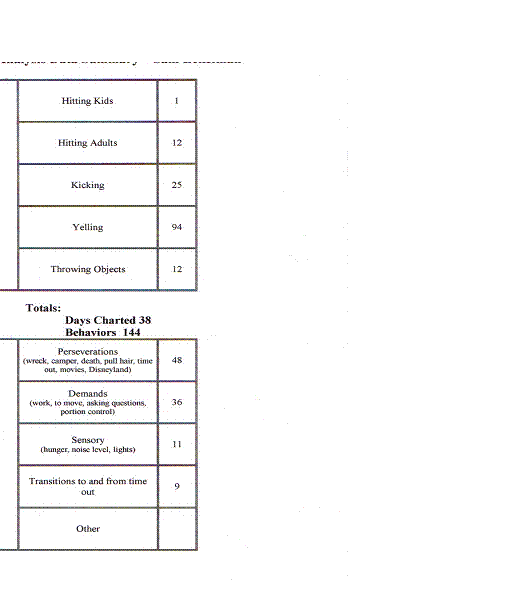
school (see Functional Analysis Data Summary). An outburst could last minutes
or hours. The behaviors included hitting, threatening to hit, kicking, throwing
things, knocking things over, destroying property, yelling, crying, running
off, and doing other unsafe acts like climbing over fences and leaving the
house without supervision at night. Once Sam got into an agitated state it was
extremely difficult to redirect him or get him to “move on” to something more
positive.
I really like the flexibility we have with the MC. There
have been afternoons where a dose hasn’t been necessary. We don’t want to give
him any medication unless we see symptoms that justify it. The AM dose is
consistent because he is going to school but the PM dose can be eliminated. We
have been giving him the PM dose 4 out of 5 days on average. Another
convenience of the MC is that we can adjust his dose slightly depending on
certain variables. If we something special planned, we can adjust the dose. For
example, last night our daughter was given a Student of the Month award. There
was a ceremony at the school board meeting that lasted 45 minutes or so. Sam
was able attend and sit throughout the ceremony without incident. He was able
to enjoy it and obviously, for us as parents, it was great that we were both
able to be there for our daughter. This is in complete contrast to what usually
happened to us when we had to take Sam somewhere like this. Before Christmas
and prior to him being on MC, our daughter performed in a school musical.
Within 10 minutes, I had to leave with Sam because he would not sit down and he
began yelling when we tried to get him to stay and watch. This incident pretty
much illustrates what life was like for us before this medication. I am not
saying that this wouldn’t happen again but now we feel we have a chance for Sam
to be successful in situations where we had little hope before.
January 20th, 2008
Since the MC trial began, Sam has not had one act of hitting,
kicking or threatening to hit. This includes school and home. SAM HASN’T GONE
THIS LONG WITHOUT AGGRESSIVE BEHAVIORS IN YEARS. Additionally, the following
improvements have occurred. I have classified these behavioral improvements
into the three categories; Reduced Behaviors, Significant Improvements, and
Mild Improvements.
Reduced Behaviors
Reduced
aggression
Reduced
anxiety
Reduced
mood swings
Reduced
crying for no reason
Reduced
negative self talk
Reduced
obsessive/compulsive behavior
Reduced
non compliance
Reduced
running off and escape behaviors
Significant Improvements
Improved
attitude and happier. Shares happiness with others appropriately. (Before
the MC trial, the only time Sam laughed was when others were angry, crying
or hurt)
Increased
flexibility to changes in routine or plans
Quicker
transition from being upset to being OK
Improved
affection to others
Improved
concentration and on task behavior at school
Improved
physical well-being. Far less complaining of stomachaches (probably because
of being off other prescriptions) and more typical diet (the
pharmaceuticals either made him habitually starving (Respirdol and
Abilify) not hungry at all (Adderall, Ritalin) or caused him to have
stomach irritation (Paxil, and Celexa). As I’ve stated, we feel much
better about giving Sam MC that we did giving him the pharmaceuticals.
Mild Improvements
Improved
language (receptive and expressive)
Reduced
self stimulation with finger play and fingers to mouth
Reduced
hyperactivity
Increased
ability to learn new information
Improved
sociability with peers
February 21st, 2008
Sam continues to do great! He is getting great reports from
school. His teachers write daily in a school journal. There has not been one
negative entry and they are considering placing him in a more typical setting.
Here are a few entries.
2-7-08
“Sam had another great day. He is such a joy to be
around.His all day smiles and giggles
are contagious.”
2-8-08
“John and I are so proud of Sam. He had a great day! He
earned a trip to the barn this afternoon.”
2-20-08
“Sam did great! Today was the “Safety Fair”. Sam was
awesome. He participated at each booth.”
2-21-08
“Another great day. We are currently working with Judith
to develop a reading program that meets his needs. He always seems so excited
to do his work and does great transitioning”.
2-27-08
Sam did great today! He was so awesome at the talent
show. We won 3rd place!”
Removing the Medical Cannabis
After discussing the matter with Sam’s MC doctor, we decided
to not give Sam any Medical Cannabis before school for a week or so to see if
some of the negative behaviors returned. I concluded there were three main
variables that could have accounted for Sam’s major improvement. One was the
medical cannabis, two was his new school, and three was that he was no longer
on any kind of prescription pharmaceuticals. On February 28th and
February 29th (Thursday and Friday) Sam went to his new school for
the first time without MC.
On both days Sam had acting out behavior that his teachers
had not previously seen. He didn’t hit but he did knock things over in his
classroom and did a lot of negative self-talk. The staff was able to get him
turned around pretty quickly but they were concerned that he was acting out at
all. They had not seen any of this behavior since he started there.
Conclusions
Sam's life has improved dramatically since he began using medical cannabis to treat his Autism Spectrum Disorder. Because Sam is doing better, we are all doing better. We have our life's back again. We still have an autistic son who faces many challenges but our lives have improved immeasurably. We can take Sam out to dinner, go shopping, visit friends, plan vacations, take him to visit his Grandparents, laugh as a family, and not be constantly worried that he is going to hurt our daughter or himself. In other words, we can live without being consumed by Sam's autism. Most importantly, SAM IS HAPPIER AND HEALTHIER.
We are going to continue to treat our son with Medical
Cannabis. No one ever questioned us when we gave Sam all the other medications
that never helped him, and in my opinion, caused him to harm. Medical Cannabis
is natural and non-toxic. The only side effects we have observed so far are
glassy and reddened eyes and an occasionally a slight drowsiness. When he wakes
each morning up he is alert and happy. He has not built up a tolerance to the
medication. We skip doses whenever we can. With the other prescriptions we were
instructed to never miss a dose or it could disrupt the medication’s effectiveness.
Medical Cannabis may not help every child with ASD like it is helping Sam but I think it should be an options for parents when considering medication. Controlled studies measuring the effectiveness of MC in the treatment of children with ASD should be conducted. More user-friendly, reliable forms of MC need to be made available to patients (inhaler, pill, liquid forms). Unfortunately, other parents and who have treated their child with MC are afraid to disclose their experiences because of possible legal retribution.
Parents need the guidance and support of a physician before trying Medical Cannabis on their own. I recommend that there be a working relationship between the MC Doctor and the child's primary physician. The primary physician at least needs to know you are going to try MC. Our MC Doctor contacted our primary physician and without revealing the Sam's identity asked him how he would feel about treatment with MC. Our MC Doctor felt this was the professionally appropriate thing to do and I agree with him. Sam's school does not know he is treated with MC and we don't feel they need to know. We have been very selective in who we share information with.
It is difficult for parents of typical children to
understand what it is like to be the parent of a child with ASD. I have worked
with Special Needs Children for over 18 years as a Special education teacher in
public schools (RSP and SDC). I have a Masters in Education with a Special
Education emphasis. Yet with all this experience, I had no idea how consuming
and life altering having an Autistic son would turn out to be. We know there
are other parents out there who are facing the same challenges we face and like
us, would do whatever they could to help their child. When I went to research
this topic a story like this would have been useful. I hope Sam’s Story might
be helpful and informative to other parents who are considering treating their
child with MC.
This paper was written by Sam’s dad and completed on March 5,
2008
This is a Functional
Analysis Assessment Data Summary before treatment with
Medical Cannabis
We are starting a campaign to support the Medical Cannabis educational video project. Please go to our donation page or click the box below to support this campaign.
Follow-Up to Sam’s Story
Using Medical Cannabis to treat Autism Spectrum Disorder
It has been almost one year since we started administering Medical Cannabis (MC) to Sam and I thought it would be prudent to write a follow-up to the paper I submitted last spring. Appropriately, I write this on Thanksgiving Day because I feel very grateful that we tried MC as an alternative to help treat his ASD.
We continue to use MC to help Sam and I can state unequivocally, that it is an effective treatment for him. If I had to qualify the level of efficacy it has I would say “very effective” or 70-80% improvement in areas such as anxiety, aggressiveness, tantrums/meltdowns, and social appropriateness. As a parent I would describe its effectiveness as a “life saver”. I know that sounds dramatic, but last year at this time, I was fearful of institutionalization or hospitalization if he did not improve. Last year, I felt hopeless. This year I have an abundance of hope.
Medical Cannabis is the only medication Sam takes. His medicine is in the form of Hash. It is made from the leaf and flower of the marijuana plant and processed using a Bubble Now hash maker. It is completely natural and simply uses ice, cold water, agitation and screens to make.
The amount we give him per dose is very small (about ½ the size of a BB) and he has not developed a tolerance since we started giving it to him January 20th of 2008. When Sam first started using MC we gave him a dose before school but now he does not take a dose until he gets home from around 3:00 in the afternoon. We discovered that most of his extreme behaviors subsided after he was on the medication for a few months and he could be successful at school without it. He does continue to need it in the afternoons. It’s easy to observe an escalation in his level of anxiety, irritability, and over stimulation and it is clear that he would not be able to manage and cope without some medication.
As I said stated it is an obvious transformation when the medical cannabis starts effecting him. His body relaxes and his mood and behaviors change from yelling, crying and mentally anguished to laughing, loveable, and content. There have been numerous times when family or friends have witnessed the transformation for the first time and they are always astonished. Any reservation they may have had regarding cannabis as a medication disappears.
There are some days when we do not give Sam his medication. If he is sick we do not give it to him and if he gets home from school and does not begin to exhibit his usual symptoms to a severe degree. We try and skip days whenever we can to decrease chances of him developing a tolerance. The days we skip are few however. He may skip 1 out of every 15 days. As I stated, we do not give it to him when he has the flu or a cold. Sam is very healthy and rarely sick.
On weekends, holidays, and summer vacation we have the flexibility to plan his medication around what is happening for the day. For instance, today we went to relatives for Thanksgiving so I gave him a smaller than normal size dose around 1 hour before we arrived (12 noon) and another smaller than usual dose this afternoon (4 PM). The total would be a dose and one-half of what he gets when we give him a single dose. This flexibility is amazingly helpful for Sam and for our family. I cannot overemphasize this point.
Sam is in the room as a type and he wants to use the computer. He laughs a lot now but his laughter is music to my ears. It is the sound that makes my heart rejoice. He is happy and as a loving father, what more could I ask for.
God Bless the Children
Follow-Up to Sam’s Story
April 2, 2009 (2nd follow-up to initial paper)
Last night I had an amazing experience with my son Sam (now 9 years of age). I did not get home until 7:30 PM because I had a class right after work. When I arrived home Sam was in pretty goods spirits and fairly calm. He and his 7 year old sister had gone out to dinner with my parents without incident. Then around 8:00 PM Sam started getting agitated and upset. He had not been given any Medical Cannabis (MC) and I usually will not give him a dose that late in the evening. However, his irritation turned into a full scale meltdown. He began perseverating on things that could not be satisfied. For instance, he kept telling me he wanted to watch a certain movie but he did not know its name. I went through all his movies with him but nothing helped. I don’t even think it had anything to do with a movie but more an intense feeling of despair and anguish. I use those words thoughtfully because they best describe how he seemed to be feeling. It’s like he is in mental and emotional agony and no level of consoling, patience, redirection, avoidance, or any other behavioral intervention helps. This went on for over an hour. He began getting physically worked up and started pounding on doors and thrashing around on his bed while crying and yelling.
I decided to give him a dose of MC even though it was 9:30 PM. The problem was it usually takes 30 minutes or longer for the effects of the medication to kick in. At the rate Sam was escalating this delay was too long. I decided to try something I had never attempted before. I was a bit hesitant but decided a more immediate administration of the medication was warranted. I told Sam that I was going to give him his medicine in a different way and explained to him that we were going to cover our heads under a blanket like we were in a tent. He willingly went under the small blanket with me and I exhaled a small amount medical cannabis smoke. I let plenty of air circulate under the blanket and he inhaled a moderate amount of smoke, no more than two breaths. He coughed slightly and I took him outside for some fresh air.
I monitored him closely for the next few hours. He immediately calmed down and stopped crying, yelling, and perseverating. His whole demeanor changed from an anguished, distraught and aggressive child to a sweet and happy one. He had not one more cry or yell for the remainder of the night. He was not “high” or “stoned” acting but rather normalized and more resembling a typical child without ASD. His regular dose subtly kicked in about thirty minute later and he was fine until he went to sleep around 11:00 PM. I observed no adverse effects whatsoever.
This incident demonstrated, at least in this one instance, that medical cannabis can be effective in deescalating acute antisocial and aggressive behaviors in children with Autism Spectrum Disorder.
Obviously, I would prefer to give Sam his medication orally and avoid these acute antisocial and aggressive behaviors at all. I do not recommend this method of administrating MC and any consideration of using MC to treat should be discussed with your child’s physician. I understand that some may consider this inappropriate. I can only share my experience with my own son. I am extremely careful I never overmedicate Sam and would never approach this matter with frivolity or recklessness. I was just amazed at how effective this was for Sam under these circumstances.
Sam’s Story Continues
November 11, 2009 (3rd follow-up to initial paper)
I want to start by thanking all the people who have written me regarding Sam’s Story. I have received many thoughtful and heartfelt emails from parents who are seeking an alternative to traditional medication, professionals who work in the ASD field, and from individuals who use medical cannabis to treat their own ASD.
These replies have originated from all over the United States and abroad. Parents from both “legal” and “illegal” states have shared their struggles, fears, successes, and most essential, hope. Those who have responded from Australia, Europe, and Canada have made clear how this is an issue that transcends boarders.
It’s natural for any parent to struggle with the uncertainty of whether he or she is “doing enough”. For parents with a special needs child, that line of self inquiry can become even more daunting and overwhelming. In no small measure, your supportive words have helped ease this persistent and nagging self-doubt and granted me some peace that Sam has an able and compassionate dad. When times are tough, I think of you all and know that we are not alone in this journey.
Sam continues to use medical cannabis successfully. He is ten years old now. He and I just got back from a weekend in San Francisco. He loves walking around Pier 39 and taking a boat ride out under the Golden Gate Bridge. He continues to do well in school and is currently involved in a horse program for autistic children. Sam still has behavioral issues but they remain mild compared to ones he had before using medical cannabis. Sam welcomes his dose of medical cannabis because he knows it helps him feel better. He doesn’t need it everyday and he still has yet to develop a tolerance. I cannot scientifically quantify how much the cannabis helps Sam but I can state, with absolute conviction, it works and it works well. Sam’s mom and I are so grateful that we are no longer enslaved by the schedules of traditional medication and can treat our son based on what is best for him and his unique physiological and psychological make-up.
Unfortunately, treating ASD and other medical conditions with medical cannabis continues to take unnecessary attacks from some in law enforcement, politics, the media, and the general public. My heart goes out to the parents in “illegal” states who are forced to break the law if they want to run a trial of MC for their child. Yet, these same parents can legally obtain the most powerful of medications and administer them to their child without controversy. I say enough of this narrow-mindedness and more power to those who advocate the legal use of cannabis as a viable medication. I say it is time to stand up and say the truth, no matter the risk.
Sam’s Story Continues
October 14, 2010 (4th follow-up to initial paper)
On Thu, Oct 14, 2010 at 11:06 AM, Y V wrote:
> Dearest Parent,
>
> My name is YV (name omitted by Steve) and I just came across your journal. Before
> I start, I would like to say that your journal brought me to tears for
> the success of Sam and the family. Congrats!
>
> I am a Supervisor working with children with autism (with an NPA) and
> have been in the field for over 7 years. I have been working with
> kids with ASD since undergrad and it wasn't until a parent
> consultation earlier today that a parent brought up using MC with her
> child. Even as a long time advocate of legalizing cannabis I never
> thought about the effects it'd have with children with ASD. I briefly
> mentioned it to my girlfriend, who stated that a recent episode of
> Private Practice (I've never seen the show, but this is according to
> her) depicted MC with kids with ASD as negative and almost "killing"
> the child because it was laced. Sensationalized fear-induced media,
> typical. Anyways, I decided to do a quick Google search for articles
> out there that had anything regarding ASD and cannabis and I came
> across your journal. What a blessing your detailed account has been!
> Your insight and openness to share your family's story with the world
> is exactly what we need in the rapid growing field of ASD.
> I suppose there's no real nature of my email other than to applaud
> your efforts, congratulate you on your findings, and tell you that you
> have someone in LA supporting Team Sam every step of the way!
> Thanks!
>
> Y
Dear Y,
Thank you so much for the thoughtful email. Your words of encouragement are greatly appreciated. Open minded, smart people like you are what we need in the field of ASD.
Sam is doing wonderfully. He still takes Medical Cannabis (MC) but only on an occasional basis. I would estimate He averages 8-10 doses a month over the last year. Sam needs MC far less than he used to but when he does, it’s very effective. We are continually grateful that we stopped traditional medication and put Sam on MC. I fear that Sam may not be the healthy and happy 11 year old that he is today if we continued treating him with doctor prescribed pharmaceuticals.
Sam has learned and continues to learn how to regulate his own behavior. As controversial as it may seem, I ask Sam if he needs a little medicine when I see he might. I let him decide. If he says yes, I give him a small dose, either with vapor or a small piece of ingested water hash. He gets "adjusted" and is better able to handle what was bothering him. It's as if the antecedent, whether sensory or behavioral, is reduced. If he says no, we search for the antecedent together and discuss how he can regulate his behavior. He is learning what causes his "discomfort" and how he can best cope with it before it causes him to act out in a negative manner. I mean, how outstanding that is! When I compare that scenario to the fixed schedules, regimens and self regulatory limitations of traditional medication, I get goose bumps running through my body.
I also work in the field of Special Education as a Special Day Class and Resource Specialist in a public high school. I’m concerned about the physical and behavioral side-effects these children may suffer due to long term use of medication. Too often, I observe teenagers that have little capacity to manage their behaviors without medication. If they miss a dose they become completely unmanageable. All too often, I see traditional meds given to a child because they are helpful to parents and the school and not in the long term best interest of the child. Successful and long term behavior modification is difficult to attain when a child in continually medicated. Additionally, the medication makes it difficult to even attempt behavior modifications. My point is meds can make everyone lazy when it comes to helping a child with difficult behaviors. “Let's just up the meds”, instead of doing the work necessary to understand what’s causing a target behavior and implementing effective behavior modification plan to reduce and eventually extinguish negative behavior with positive ones. Constant use of powerful medications can make a child dependent on that medication. Obviously, this end is just what the pharmaceutical companies are hoping for.
I wish more comprehensive research could be done on the efficacy of MC in treating ASD and other maladies affecting children. The psychotropic free cannabinoid that is being used by cooperatives like Harborside in Oakland could be an effective alternative to mind altering cannabis in treating children with ASD. Parents need to assertively advocate for their right to trial MC in treating their child with ASD and more professionals need to educate themselves on MC and its possible effectiveness in treating ASD.
Certainly, I am not a doctor and do not pretend to be an expert. I can only relate my experiences as anecdotal evidence of the efficacy of MC in treating ASD symptoms. Additionally, I am not dismissing some real benefits traditional medication may provide for some children with ASD. I only ask that we consider MC as a way to treat ASD and that those in the legal, medical and educational community, respect parents who want to trial MC under the supervision of a qualified MC doctor.
I wish you the best with your professional and personal pursuits.
Steve
Sam’s Story Continues
September 21, 2012 (5th follow-up to initial paper)
It has been almost two years since I last updated Sam’s Story. When I reflect on Sam’s journey with Medical Cannabis (MC), I always become somewhat emotional because of the immense gratitude I feel. The extreme, problematic behaviors Sam had when I first started this journal are, for the most part, extinguished. How much the MC is responsible for his improvement is difficult to quantify. For the last five years, Sam has attended a non public school specifically designed for children with ASD. This program and the highly skilled and loving people who work there have certainly contributed to Sam’s improvement. Maybe Sam just improved with age and the natural onset of self coping skills. Regardless, I have absolutely no doubt that stopping the pharmaceuticals and putting him on MC has been a major factor in his improvement.
I cannot imagine where Sam would be today if we continued treating him with traditional medicines. His mom and I often laugh at how the MC saved both Sam’s life and ours. Those who have experienced the devastation extreme ASD behaviors can have on the individual and the family can relate. I only wish every family and every individual suffering with ASD could be as fortunate as we have been. As one mother wrote me, “I am not looking for a cure. I just want my son to have some happiness and for our family to be able to enjoy the life given us.” One of the most common things I hear about Sam is that he is such a loveable and happy kid. Those words are worth more than the highest pile of gold.
Sam uses MC about 2-4 times per week. He ingests it in the form of hash. The dosage he takes today is equal to the dosage he took when he first started treatment almost 5 years ago. Sam is 13 years old now and is 5’ 8” tall. The amount we give him is about ¾ the size of a BB. The hash is very concentrated medicine but it is amazing such a small dosage continues to be effective. He has not built up any tolerance to the medication.
We find the flexibility of the MC one of its greatest assets. If he is doing OK we don’t give him any. If he starts to get agitated or we can see he is having a difficult time coping, we give him a dose and within 20 minutes he is relaxed, happy and better able to cope with his environment and his internal struggles. We give him some MC before antisocial behaviors escalate. The medicine is almost always effective and I use the word always judiciously.
Sam’s Story continues 6th follow-up to
initial story
January 24, 2014
Sam has been using medical cannabis for over six
years. He uses it about 3 to 4 times per week, usually in the late afternoon.
He ingests it in the form of concentrated hash made from a Bubble Now machine,
screens, and the pure flowers of organically grown hybrid strains. Amazingly,
his dosage is about the same size as when he began using cannabis 6 years ago.
We began treating Sam with cannabis when he was
eight years old. He turned fourteen this last September. I still want to say
he’s thirteen. He is 5’10” and weighs about 160 lbs. He wears a shoe size of 12
and next year will be entering high school. In my heart he is still my little
Sammy. I have a typical daughter named Lucy who is twelve years old. I struggle with her growing up but it’s just
different with Sam. I’m sure parents of an autistic or special needs child can empathize
with my concerns and fears.
Maybe it’s the thought of my own mortality that
scares me the most. Who’s going to be there to take care of Sam when I’m gone?
Who’s going to be there to understand and tolerate his idiosyncrasies? Who’s
going to take him to all his favorite places and feed him all his favorite
foods? Who’s going to grow, make, and give him his medicine? Who’s going to
love him like I do?
I want to again thank so many who have contacted me
with their thoughtful and sincere emails. You help me remember that I am not
alone. Autism’s greatest curse is the isolation it brings to both those who are
afflicted and their families. I have often considered myself the autistic dad. To be sure, the years
of having an “autism centered” life have taken a toll on me yet I am willing to
accept those consequences because I’m Sam’s dad.
I am very grateful that we found any medication that
helps Sam overcome the antisocial behaviors that come with severe autism. The bonus
that cannabis has negligible, negative side effects and can be grown
organically in my backyard certainly adds to its appeal. We weren’t looking for
cannabis to be the solution. It was only tried after years of failed and, often
disastrous, trials with traditional medication.
Many times I have thought and written about how
fortunate I am to live in a state and a county that allows legal and safe
access to cannabis. I have been able to grow organic cannabis and make Sam’s
medicine from the beginning. I haven’t had to be secretive or worried that the
police are going to arrest or fine me. Unfortunately, as of today, that has changed.
The county where I reside has made it illegal to grow cannabis outside. Now it
can only be grown indoors in a detached shed with a limit of 12 plants. I
anticipated this outcome so I am prepared to follow the new ordinances. I am
fortunate that I have the resources to grow indoors. It is too expensive for
many people to run lights, filters and fans, let alone have a grow shed.
It is disappointing that those in power have decided
to take such drastic measures. Common sense and reasonable compromise were lost
in this polarizing debate and the victims are legitimate patients like Sam. There
must have been a solution besides the proverbial “throwing the baby out with
the bath water”. The pendulum has swung back toward prohibition. I guess only
time will allow it to settle somewhere in the middle.
I welcome any comments or questions regarding this topic, whether it be from a parent, a professional or a journalist. I am convinced that MC can help other children with ASD. Certainly, not all individuals with ASD will benefit from MC, but based on what we witness on a regular basis with Sam, I am convinced many would.
Sincerely,
Sam’s dad
If you would like to contact me, I can be reached via email at eeshman1@charter.net